
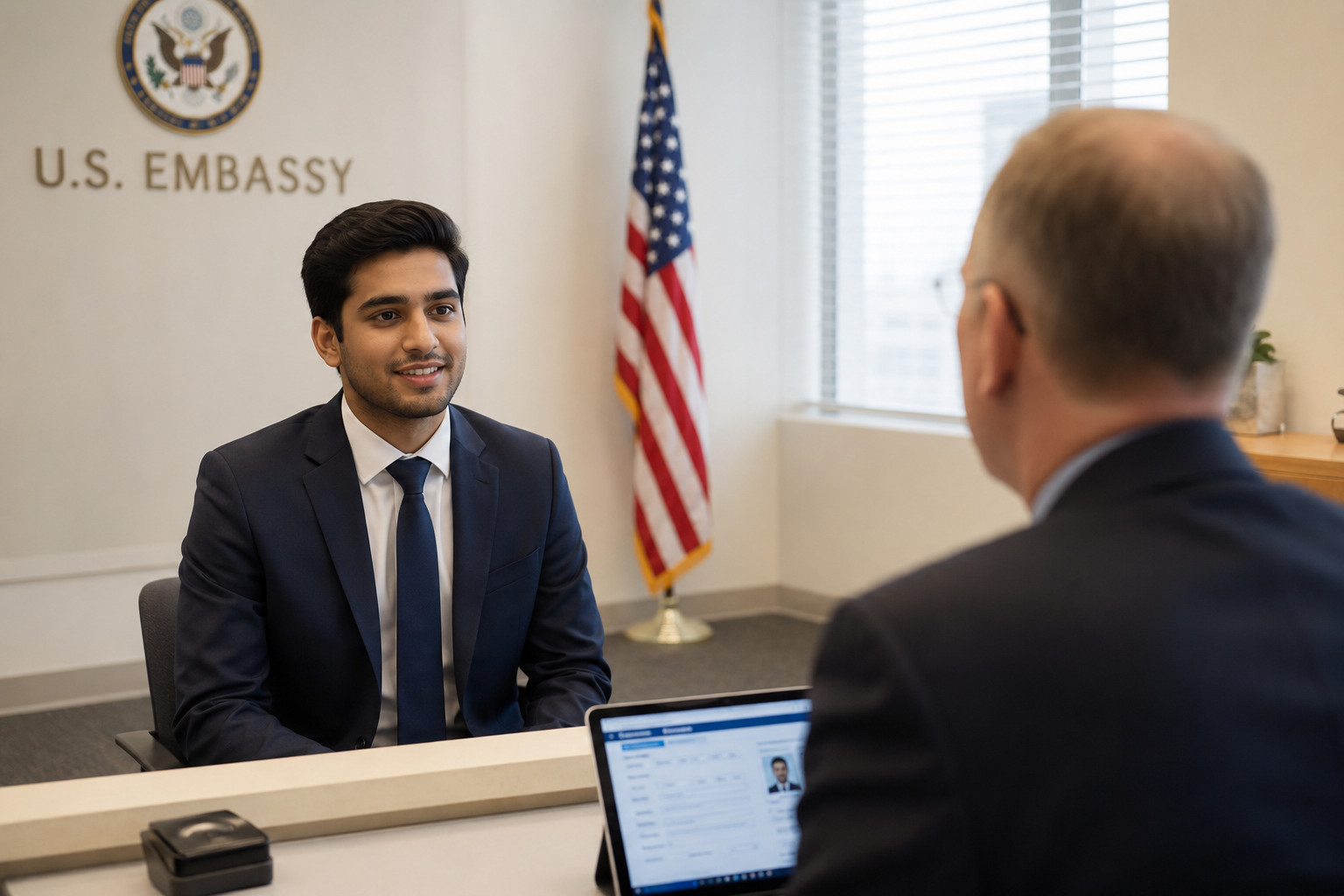
Dreaming of studying in the United States? You are not alone. Every year, thousands of Pakistani students take the exciting step of applying to top American universities — but before you board that flight, there is one critical hurdle you must clear: the US student visa interview. At Fast Consultants, we have helped hundreds of Pakistani students successfully navigate this process, and in this comprehensive guide, we share everything you need to know to walk into your visa interview with confidence. Read it, to learn the Interview Tips for USA Visa.
Whether you are applying for an F-1 student visa, a J-1 exchange visa, or exploring other student visa options for the USA, this guide covers the best interview tips, commonly asked questions, document checklists, and expert strategies tailored specifically for Pakistani students.
Why the US Student Visa Interview Matters So Much for Pakistani Students
Pakistan is considered a high-scrutiny country by the United States Embassy. This means that Pakistani applicants must meet a higher standard of documentation and communication during their F-1 visa interview. The consular officer needs to be convinced of two core things:
- You have genuine academic intent — you are going to study, not stay illegally.
- You have strong ties to Pakistan — you will return home after completing your studies.
Understanding this dual requirement is the foundation of a successful US student visa interview. Our team at Fast Consultants provides personalized Study Abroad Counselling to help students build a convincing and authentic case for both.
Step 1: Before the Interview — Prepare the Right Documents
A well-organized document file is your best friend. Missing or unorganized documents can raise red flags. Here is a checklist of what Pakistani students must carry to a US visa interview:
Essential Documents for US F-1 Student Visa Interview
- Valid Pakistani Passport (at least 6 months validity beyond your intended stay)
- DS-160 Confirmation Page (Online Nonimmigrant Visa Application)
- SEVIS Fee Payment Receipt (Form I-901)
- Visa Interview Appointment Confirmation Letter
- Form I-20 (Certificate of Eligibility for Nonimmigrant Student Status) — issued by your US university
- University Acceptance Letter
- Academic Transcripts and Certificates (Matric, FSc/A-Levels, Bachelor’s Degree if applicable)
- English Language Test Scores — IELTS, TOEFL, or Duolingo English Test
- Standardized Test Scores — SAT, GRE, or GMAT (if required by your programme)
- Financial Documents (bank statements, property documents, income proof, affidavit of support)
- Scholarship Award Letter (if applicable)
- Photographs (as per US visa specifications)
Our Admission Application Support team ensures that every document is prepared and organised correctly before you sit for your interview. We also provide dedicated USA Study Visa Guidance and Filing support so that no form is missed or incorrectly filled.
Step 2: Understanding the US Student Visa Interview Format
At the US Embassy in Islamabad (and the Consulate in Karachi), your visa interview is typically a 2–5 minute conversation with a consular officer. It is short, direct, and decisive. The officer asks quick questions to assess your intent, financial stability, and ties to Pakistan.
There is no written test. It is entirely spoken. This is why mock interview preparation is critical — and it is something our counsellors at Fast Consultants do with every student before their appointment.
What Does the Visa Officer Look for?
- Clarity and Confidence: Can you clearly explain your study plans?
- Financial Stability: Can your family afford your US education?
- Academic Intent: Do you know about your chosen university and programme?
- Return Intent: Do you have family, career, or property ties in Pakistan?
- English Proficiency: Can you communicate effectively in English?
Step 3: Most Commonly Asked US Visa Interview Questions for Pakistani Students
Below are the top questions Pakistani students are asked at US visa interviews, along with guidance on how to answer them effectively.
1. Why do you want to study in the USA?
This is the most important question. Do not say generic things like “America has good universities.” Instead, be specific. Mention your chosen university, the programme ranking, the faculty, or a specific research opportunity. Show that you have done your research and have a clear academic goal.
Example: “I have been accepted to the University of Texas at Dallas for MS in Computer Science. Their programme is ranked among the top 20 in the USA, and they have a strong collaboration with leading tech companies, which aligns with my career goal of working in AI research back in Pakistan.”
2. Why this specific university?
Know your university inside out — location, ranking, faculty, programme structure, and campus life. Consular officers can tell instantly if a student randomly picked a school. Research at least 5–6 things about your institution before the interview.
3. How will you finance your studies?
Be completely transparent and prepared. Mention your sponsor (parent, family member, scholarship), the exact amount available, and show supporting bank statements. If you have a scholarship, bring the award letter and mention the scholarship amount confidently.
Pakistani students who have been awarded scholarships should definitely explore our Scholarships Page for a full breakdown of financial aid options available for US study.
4. What will you do after completing your degree?
This is where you demonstrate ties to Pakistan. The officer wants to know you plan to return. Mention a specific career plan — joining your family business, working in a Pakistani company, contributing to a specific sector like healthcare or engineering in Pakistan.
5. Do you have any relatives in the USA?
Answer honestly. Having relatives in the US is not an automatic rejection — but lying is. If you have relatives there, explain that your purpose is education, not immigration, and emphasise your plans to return home.
6. Have you applied for a US visa before?
If you have been rejected before, be honest. Explain what has changed since your last application — stronger finances, a confirmed I-20, better English scores, or clearer study plans. A previous rejection, when addressed honestly, does not automatically disqualify you.
7. What is your undergraduate CGPA / academic background?
Be ready to talk about your academic record confidently. If your CGPA is low, have a reason and show upward progression. Highlight relevant coursework, projects, or extracurriculars that support your chosen programme.
8. Which other universities did you apply to?
It is fine to mention multiple applications. It shows diligence. However, always make it clear why your chosen school is your top choice and the best academic fit.
9. What is your field of study, and why this specific field?
Know your programme thoroughly. Read about the courses, professors, research labs, and career outcomes. Show genuine passion for your subject. Officers are trained to detect rehearsed or hollow answers.
10. Do you speak English fluently?
The interview itself is conducted in English. Your spoken English during the interview is a live demonstration of your ability. Speak clearly, at a moderate pace, and avoid over-rehearsed lines. Natural conversation impresses officers far more than memorized scripts.
Step 4: Top Interview Tips for Pakistani Students — Do’s and Don’ts
DO’s for Your US Visa Interview
- Dress formally and professionally — first impressions count
- Arrive at the embassy/consulate at least 30 minutes early
- Organize your documents in a clearly labelled folder
- Answer questions directly and concisely — do not over-explain
- Speak in English throughout the interview, even if the officer addresses you in Urdu
- Make confident eye contact with the consular officer
- Be honest — every answer must be truthful and verifiable
- Know your I-20 and university details by heart
- Practice mock interviews with a professional counsellor
DON’Ts for Your US Visa Interview
- Do not memories scripted answers — they sound robotic and unconvincing
- Do not bring people who are not invited into the interview area
- Do not lie about finances, family ties, or previous visa rejections
- Do not speak too fast or too softly — clarity matters
- Do not show nervousness by fidgeting or avoiding eye contact
- Do not give long, rambling answers — be direct and concise
- Do not bring unnecessary documents — stick to what is relevant
- Do not use a mobile phone inside the embassy premises
Step 5: Demonstrating Strong Ties to Pakistan
One of the biggest reasons Pakistani students get rejected for a US student visa is the failure to demonstrate strong ties to Pakistan. Here is how you can effectively communicate your intention to return:
- Family ties: Mention parents, siblings, spouse, or dependents in Pakistan
- Property ties: Mention property or assets owned by your family in Pakistan
- Career ties: Mention a job offer, family business, or specific career opportunity awaiting you in Pakistan
- Academic ties: If you are going for a short programme, show how it aligns with career goals you intend to pursue in Pakistan
- Community ties: Mention any community roles, volunteering, or leadership responsibilities you have in Pakistan
During our Study Abroad Counselling sessions, we work specifically on helping students identify and articulate their ties to Pakistan in a credible and compelling way.
Step 6: Handling Financial Questions Like a Pro
Financial questions are among the most scrutinized aspects of the Pakistani student visa interview. Here is how to handle them:
Preparing Your Financial Evidence
- Bank statements for the last 6–12 months showing consistent funds (not sudden large deposits)
- Property ownership documents or rental income proof
- Salary slips, business registration certificates, or income tax returns of your sponsor
- Scholarship award letters showing the exact amount and duration
- Affidavit of financial support from your sponsor
What to Say During the Interview
State the funding source clearly: “My education will be funded by my father, who is a businessman in Lahore. Our family has sufficient funds to cover all tuition and living expenses for the full duration of my programme.”
If you have a partial scholarship, explain how the remaining amount will be covered. Never be vague about finances — vagueness raises suspicion.
Step 7: Choosing the Right Universities to Strengthen Your Visa Case
Your choice of university matters significantly. Attending a well-ranked, SEVP-certified institution with a strong track record of enrolling international students strengthens your visa application. Explore our curated list of Universities to find programmes that are both academically excellent and visa-friendly for Pakistani students.
Avoid applying to too many low-ranked or obscure colleges with no international student history — this can raise flags about your academic intent.
Step 8: What Happens If Your Visa Is Refused?
A visa refusal is not the end of the road. In Pakistan, F-1 visa refusal rates have fluctuated, but students who reapply with a stronger case do get approved. Here is what to do after a rejection:
- Ask the officer for the refusal reason — they are obligated to give you a general reason
- Do not reapply immediately — take time to strengthen weak areas
- Gather stronger financial evidence if that was the issue
- Prepare a more compelling statement of ties to Pakistan
- Practice mock interviews to improve your spoken communication
- Contact our team for a post-rejection case review
Our Post Visa Support and Fast Track Programs are designed to help students who have faced challenges in the visa process get back on track with a renewed and stronger application.
Step 9: What to Expect After a Successful Visa Approval
Congratulations — you got your visa! But the journey does not stop there. Here is what Pakistani students need to do before departure:
- Confirm your university enrolment and housing arrangements
- Book your flight and prepare for airport procedures
- Understand US customs and immigration rules for F-1 students
- Connect with your university’s International Student Office
- Open a US bank account and plan your finances
- Attend orientation programmes and familiarize yourself with your campus
Fast Consultants offers a dedicated Pre-departure Briefing session for all students heading to the USA. This covers everything from what to pack, how to handle US customs, to understanding your rights and responsibilities as an F-1 visa holder.
Frequently Asked Questions: US Visa Interview for Pakistani Students
How long does the US student visa interview take?
Typically 2 to 5 minutes. Consular officers are experienced and decisive. Make every second count.
Can I bring my parents to the US visa interview?
Parents or guardians are generally not allowed inside the interview area. However, you may bring them to the embassy premises for support outside the interview room.
What is the US visa interview success rate for Pakistani students?
The approval rate varies by year and individual circumstances, but students who are well-prepared, financially documented, and academically credible have significantly higher success rates.
How many times can I apply for a US student visa after rejection?
There is no limit on the number of times you can apply. However, you must demonstrate what has changed in your situation since the previous rejection to have a realistic chance of approval.
Is IELTS mandatory for the US student visa interview?
The consular officer does not technically require IELTS to grant a visa — but your university will require it for admission, and you must provide proof of language proficiency. Your English communication during the interview itself also plays a role.
For more commonly asked questions, visit our detailed FAQs page or reach out to our advisors directly.
How Fast Consultants Helps Pakistani Students Succeed in US Visa Interviews
At Fast Consultants, we are not just a visa filing service — we are your end-to-end study abroad partner. Here is how we support Pakistani students throughout the entire journey:
- Study Abroad Counselling — Understanding your academic profile and identifying the best-fit US universities
- Admission Application Support — Preparing strong applications, SOPs, and recommendation letter guidance
- USA Study Visa Guidance and Filing — Complete DS-160, SEVIS, and I-20 support with expert guidance
- Scholarships — Identifying and applying for financial aid to strengthen your visa case
- Universities — Curated list of visa-friendly, SEVP-certified institutions in the USA
- Pre-departure Briefing — Preparing you for life in the USA before you leave Pakistan
- Post Visa Support — Continued support even after your visa is granted
- Fast Track Programs — Accelerated pathways for students with tight timelines
You can also browse our General Guide for more articles, tips, and student success stories. And to learn more about who we are and why thousands of Pakistani families trust us, visit our About Us page.
Final Words: Your US Dream Is Achievable
The US student visa interview is not designed to trick you. It is designed to verify that you are a genuine student with a clear purpose, the financial means to study, and the intention to return to Pakistan. When you walk in prepared, honest, and confident — you dramatically increase your chances of approval.
At Fast Consultants, our mission is to make that preparation as thorough and stress-free as possible. From the moment you decide to study in the USA to the day you land on American soil — and beyond — we are with you every step of the way.
Ready to start your journey? Get in touch with our team today and take the first confident step toward your American education dream.